
AI agents are systems that use a model to interpret a goal, select actions or tools, observe results and continue through a task. The term is used broadly. Some products call a single model-assisted action an agent; others coordinate multiple steps, services or specialized components. The label does not establish autonomy, reliability or suitability for consequential work.
From model response to task loop
A basic agentic loop may include a request, a plan, tool selection, an action, a returned observation and a decision about what to do next. Tools can include search, databases, code execution or business software. Orchestration determines which steps can run, how state is stored and when a person must approve an action. Each additional step creates opportunities for context loss, errors and unexpected behavior.
Automation is not synonymous with an agent. A fixed rule-based workflow can move information between systems without a model deciding what to do. A model can also assist one step inside a conventional workflow. Choosing the simplest approach that meets the need can reduce uncertainty and make behavior easier to test.
Bound the job and tool access
Start with a narrow task and explicit completion criteria. Define what the system may read, what it may change and what it must never do. Read-only access is generally easier to manage than write access; actions with external impact should require clear authorization. Use least-privilege permissions, separate sensitive environments and maintain an audit trail appropriate to the task.
Tool descriptions, input validation and output checks matter. A model may choose the wrong tool, supply malformed arguments or interpret returned information incorrectly. Restricting available actions and validating requests can reduce the reachable failure space. It cannot eliminate error, so establish an escalation route and a way to stop or undo actions where possible.
Human-in-the-loop design
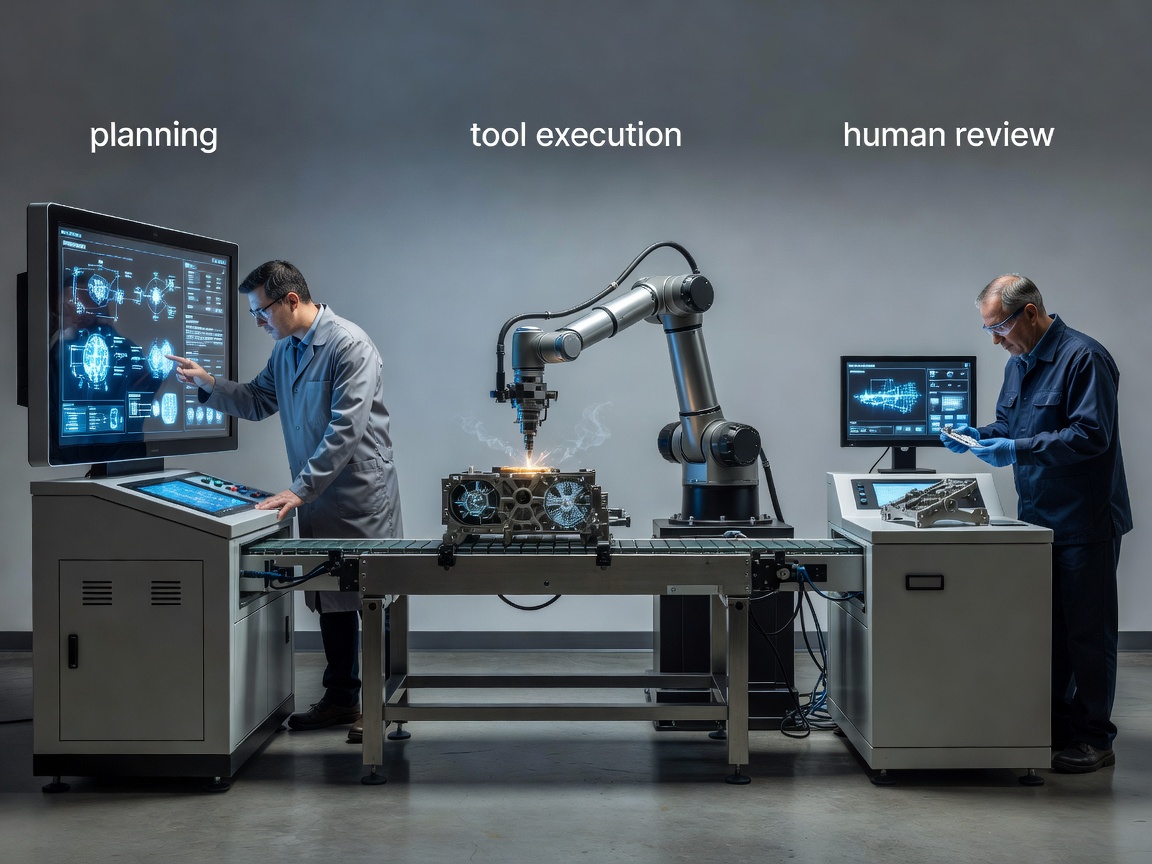
Human oversight should be a designed operating step, not a vague assurance. Decide which actions require review, what context a reviewer receives and how a reviewer can reject or correct a proposed action. Reviewers need enough time and authority to intervene. If approvals become a rapid click-through ritual, the control may exist on paper but provide little practical protection.
Some tasks can be automated after they have been tested in bounded conditions; others should remain assistive. Consider the potential harm of a wrong action, the reversibility of the result, the quality of available evidence and the cost of review. High-impact decisions demand stronger governance than low-risk internal drafting.
Reliability, monitoring and failure modes
Common failure modes include incomplete plans, loops, stale context, tool outages, ambiguous instructions, fabricated intermediate information and compounding small errors. Agents may appear successful on a short demonstration while failing on varied real inputs. Evaluate complete tasks, including exceptions, interruptions and recovery—not just the best-case run.
Monitoring should cover more than whether a process completed. Track failed actions, retries, permission denials, unexpected tool use and human corrections. Store only the logs needed for safe operations, and protect them because they may contain sensitive inputs. Changes to models, prompts, tools or data can change behavior, so versioning and regression checks are important.
Security and prompt boundaries
Agent systems can be exposed to malicious or misleading content in documents, websites and messages. Treat retrieved material as input, not instruction. Keep secrets outside model-readable context where possible, scope credentials and separate trusted control logic from untrusted content. Review third-party connectors and define what data they can access.
Security requires defense in depth: identity controls, permissions, input and output checks, isolation, monitoring and incident procedures. A system prompt alone is not a security boundary. Teams should identify who owns configuration, who reviews incidents and how access is revoked.
Practical deployment limits
Agents are most plausible where tasks are bounded, tools are well defined, outcomes can be checked and mistakes are recoverable. They are less suitable when instructions are ambiguous, the environment changes unpredictably or errors carry high consequences without effective review. Latency and usage costs can also grow as a task takes multiple model and tool calls.
Compare an agent with a deterministic workflow, a human-operated process and a simpler model-assisted step. A more autonomous design is not automatically better. The right division of work may be to let software gather context and draft a recommendation while a person makes the final decision.
What to Know
Present-day agents do not reliably perform every task. Capability depends on the model, tools, constraints, context and evaluation conditions. “Autonomous” should be described precisely: what can happen without approval, for how long and with what limits?
What to Watch
Watch for better permission systems, transparent action logs, robust evaluation and safer pause-and-resume behavior. Also watch how products make errors visible and give operators meaningful control rather than hiding complexity behind a single button.
Good For
This guide is useful for teams considering multi-step automation, tool-using assistants or workflow redesign. Begin with a low-risk, measurable task and expand only when performance and control are clear.
Read alongside AI Products & Platforms, AI Infrastructure and Startup Discovery.