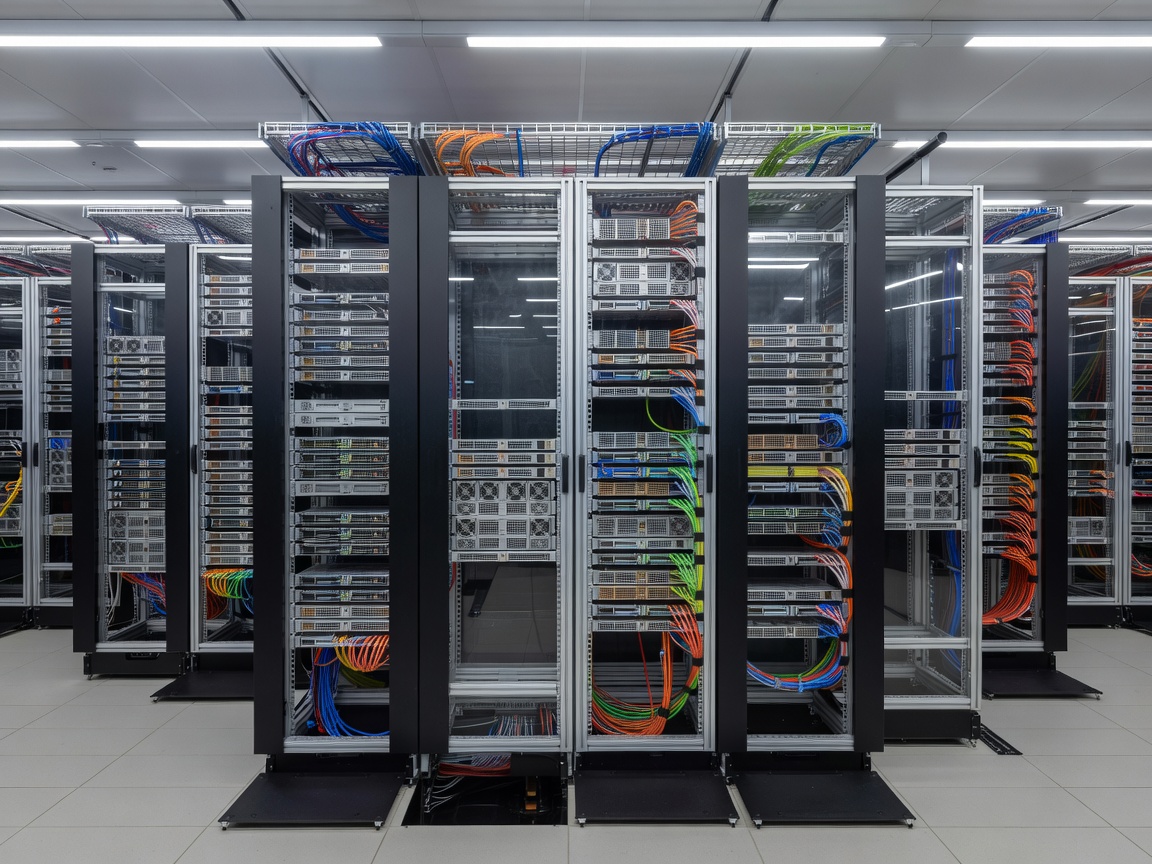
AI infrastructure is the set of hardware and software that prepares data, runs models and delivers results to applications. It includes accelerators, servers, cloud services, storage, networking, orchestration and monitoring. A product team rarely chooses each layer in isolation: compatibility, availability, operational skill and workload shape influence the practical options.
Compute and accelerators
General-purpose processors handle many tasks; specialized accelerators are designed to execute particular mathematical operations efficiently. Different accelerator architectures, memory configurations and software ecosystems can suit different workloads. The label “AI chip” alone does not establish speed, cost or suitability. Selection depends on model size, batch patterns, precision needs, memory movement, software support and access conditions.
Training and inference have different profiles. Training updates model parameters and can require sustained high-throughput computation. Inference runs a trained model to answer requests, often with different latency and utilization goals. A system optimized for one stage may not be the preferred choice for another.

Inference: serving a model
Inference infrastructure accepts requests, schedules work, loads model components and returns results. Relevant considerations include response time, throughput, concurrency, availability and the cost of keeping resources ready. Batching can improve resource use but may affect latency. Model compression or smaller models can reduce some demands, while introducing quality or maintenance trade-offs that require evaluation for the use case.
Serving can happen in a public cloud, a private environment, on-device or across a hybrid arrangement. Cloud services may reduce initial operations work and offer flexible access, but bring dependency, data-location and variable-use considerations. On-device execution can support local processing and responsiveness, though hardware limits and update mechanisms matter.
Data pipelines, storage and networking
Models are only one part of an AI system. Data pipelines ingest, validate, transform and route information. Storage choices affect access patterns, retention and governance. Networking connects services and can influence latency, reliability and transfer expense. Poorly controlled data pipelines can create stale context, duplicated records or unwanted exposure, even when the model endpoint itself is configured carefully.
Map the path from source to result. Identify the data owner, transformations, temporary copies, logs and retention. Consider whether records need to be refreshed, removed or corrected and how those changes propagate. For retrieval-based products, the quality and freshness of indexed material can matter more than simply increasing model capacity.
Deployment and operations
Model deployment includes packaging, versioning, rollout, monitoring and rollback. Teams need to know which model version served a request, what configuration was active and how to compare behavior after a change. Observability can include system health, latency, resource use and task-specific quality checks. A green server dashboard is not evidence that generated results are useful.
Scaling decisions should match demand rather than assume continuous growth. Workload peaks, idle capacity, redundancy and service-level expectations affect the operating plan. Infrastructure costs can include compute, storage, network transfer, orchestration, evaluation and human operations. Measure the full workflow where possible, and be explicit when costs remain uncertain.
Energy efficiency and practical trade-offs
Energy use is influenced by hardware efficiency, utilization, cooling, workload design and the location and operation of facilities. Smaller or more efficient models may reduce resource needs for some tasks, but suitability depends on quality requirements. Caching repeated work, right-sizing capacity and avoiding unnecessary model calls can help reduce waste. No single architecture is universally most efficient.
Infrastructure strengths include control over deployment, predictable performance under known conditions and the ability to tailor resources. Limitations include operational complexity, scarce expertise, supply constraints, integration work and changing software support. Managed services simplify some responsibilities but reduce control and may deepen vendor dependency.
How to compare infrastructure options
Describe the workload first: model type, input size, request pattern, latency target, data sensitivity and failure tolerance. Then compare options on compatibility, availability, total cost drivers, monitoring, portability and recovery. Ask whether the proposed architecture has been evaluated on the intended workload. Avoid general benchmark claims that do not reflect your data, software and service conditions.
What to Know
Infrastructure is a stack of coupled decisions. A faster accelerator may not improve an application if data access or network delays dominate. A lower unit cost can be offset by integration and operations. Keep deployment requirements, workload assumptions and unknowns visible.
What to Watch
Watch for improved inference efficiency, more portable deployment tooling, transparent energy reporting and simpler ways to compare workload-specific costs. Capacity, software compatibility and energy constraints will continue to shape what is practical in each operating environment.
Good For
This overview is useful to product leads, engineers and technical buyers translating an AI use case into a deployable architecture. It is a map for questions, not a hardware recommendation or benchmark report.
Continue with AI Products & Platforms, AI Agents & Automation or AI Venture Trends.